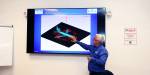
“The experts have been selected by IEEE, the world’s largest and most prestigious scientific organisation in electrical and electronic engineering and information science,” says OsloMet Professor Jianhua Zhang, who organised the workshop on 21 April 2026.
The three keynote speakers at the IEEE Distinguished Lecturers Workshop are all current or former Distinguished Lecturers with the IEEE Antennas and Propagation Society (AP-S), and one of them is an IEEE Fellow.
This means that they are experts with strong academic track records and excellent communication skills. They are invited to give lectures at universities, conferences and IEEE events around the world.
“They are not only internationally recognised researchers, but also highly skilled educators who excel at communicating knowledge and new research advances in their fields.”
IEEE Distinguished Lecturers typically hold the role for a period of two to three years.
Beneficial for OsloMet
OsloMet was the first and only stop in Norway on the experts’ tour of Northern Europe. The tour also includes the major research universities KTH and Chalmers in Sweden, and Aalto and Oulu in Finland.
“This workshop can be highly beneficial to the research activities of staff and research students at OsloMet. It can also help strengthen OsloMet’s academic reputation and raise the university’s international profile in science and technology.”
An increasingly important field of research
“Why is this field of research particularly important now?”
“AP-S focuses on research into antennas and electromagnetics, the physics-based part of the field, as well as next-generation technologies for communications and signal processing. These include radar and technologies for detecting stealth aircraft, which are military aircraft designed to be more difficult to detect by radar.
“With the development and widespread use of artificial intelligence (AI), machine learning, the Internet of Things (IoT), digital twins and high-performance computing (HPC), this field is becoming increasingly important. The technology is a key enabler for a wide range of practical applications, both civilian and military.”
OsloMet’s research in the field
“What does OsloMet research in this area?”
“We have expertise in statistical signal processing, the use of evolutionary algorithms to optimise the design of antenna structures, and the combination of data-driven AI and machine-learning methods with physics-based models for large-scale complex dynamic systems.”
“These are all important research topics -related to the field.”
OsloMet was selected as the only university in Norway to be visited on the Northern European tour, primarily because of Professor Jianhua Zhang’s interdisciplinary research and academic network, as well as OsloMet’s central location in Norway.
The next-generation communications technology
“What are some of the most exciting developments in the field at the moment?”
“Some of the most exciting areas include technologies for detecting stealth (or low-visibility) aircraft; combining AI, physics-informed modelling and numerical analysis methods to model, analyse and simulate complex dynamic electromagnetic systems; integrating communications, computing and control; and 6G communications technology for the Internet of Things, automated vehicles and humanoid robots.”
“What will 6G and ‘intelligent radio environments’ mean for ordinary users?”
“6G is the next-generation communication technology and will provide the foundation for areas such as high-speed mobile communications, including smartphones with faster internet access, self-driving and connected vehicles, cybersecurity, and security mechanisms for future agentic AI systems."
“The latter could include, for example, autonomous AI agents and mobile intelligent robots carrying out tasks in the home,” says Jianhua Zhang.
Different aspects of electromagnetic waves
The three speakers presented different aspects of research into electromagnetic waves, the technology underlying mobile communications, antennas and radar, among other things.
Professor Özlem Özgün reviewed systematically Computational Electromagnetics (CEM) from basic theory until advanced topics and challenges. She showed how multiphysics computational models can be constructed to investigate how antennas and communications systems will perform before they are actually built. By combining different computational methods, and increasingly artificial intelligence, machine learning and digital twins, researchers can analyse and simulate ever more complex systems.
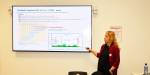
Professor Özlem Özgün Photo: Olav-Johan Øye
Professor Levent Sevgi discussed the problems for modelling and simulating electromagnetic scattering and diffraction. He explored what happens when radio waves encounter buildings and other objects. The waves can be reflected or bend around obstacles. This is one of the reasons why a mobile phone can remain connected to a base station even when there is no direct line of sight between them. Ou can see picture of him at the top of the article.
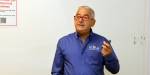
Professor Levent Sevgi Photo: Olav-Johan Øye
Professor Mats Gustafsson presented his latest theoretical breakthrough on the number of spatial degrees of freedom (NDoF) and introduced an analytical approach for estimating the NDoF between arbitrarily shaped transmitting and receiving regions. His research examines how much independent information can be transmitted, received, or represented by an electromagnetic system. The resulting expressions of NDoF have a simple geometrical interpretation in terms of shadow areas measured in wavelengths. This elegant theoretical result could help us make a deeper understanding of fundamental limits and computational complexity across a broad range of electromagnetic problems.
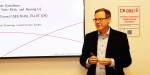
Professor Mats Gustafsson Photo: Olav-Johan Øye
