The Horizon Europe project UR-DATA (Twinning for Excellence in Smart and Resilient Urban Development: Advanced Data Analytics Approach) focuses on advancing research excellence in smart and resilient urban development through innovative data analytics and international knowledge exchange.
Professor Claudia van der Laag interviewed H.E. Ambassador Kristin Melsom in April 2026.
Building sustainable, cross-border partnerships
Ambassador Melsom described UR-DATA as a model for building sustainable, cross-border partnerships between universities and research institutions. The project was recently showcased as part of an initiative by the Nordic embassies in Serbia, highlighting smart and green cities.
“These types of projects are important for building long-term collaboration involving researchers and students from both universities,” Melsom noted.
She emphasised that such initiatives not only inspire Serbia’s green transition but also contribute to strengthening innovation capacity and economic development.
Science diplomacy in practice
Melsom positioned UR-DATA within the broader context of science diplomacy, arguing that global challenges such as climate change and energy security cannot be addressed by countries acting alone.
“They require shared data, coordinated research and cross-border scientific expertise,” she said.
According to the ambassador, science diplomacy can also create channels of communication when traditional diplomatic avenues are limited, fostering people-to-people connections through bilateral and multilateral cooperation.
She stressed that research has an impact far beyond academia. Scientific knowledge informs public policy and everyday life, not only through technological innovation but also by providing evidence on how people live and interact with their environments. Such insights are essential for effective local and national decision-making.
Shared priorities: climate action and energy transition
Looking ahead, Melsom identified climate action, environmental sustainability, green urban development and energy transformation as key areas for future Norway–Serbia cooperation. She noted that Serbia’s challenges — including air quality, waste management, energy efficiency and climate adaptation — align closely with Norwegian expertise and broader Nordic priorities.
At the same time, Serbia’s continued reliance on coal, increasing electricity demand and the need for grid modernisation create opportunities for collaboration on renewable energy and energy security.
Norway’s research strengths and broader cooperation
Melsom also highlighted Norway’s strengths as an international research partner, pointing to its globally connected research community, strong performance in competitive European funding programmes and recognised leadership in several high-impact research fields. These strengths position Norwegian institutions such as OsloMet as valuable and trusted partners in large international research consortia.
The ambassador pointed to long-standing Norway–Serbia cooperation in areas such as child and youth mental health and initiatives that empower women in rural communities. These examples, she said, demonstrate how well-designed partnerships can generate tangible benefits for society.
Her message to students and early-career researchers was clear: embrace international and interdisciplinary collaboration.
“Innovation happens where perspectives meet, and integrity, openness and respect for evidence are vital in a fast-changing world. Let your work contribute to something larger than yourself,” she said.
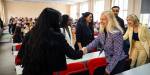
In the photo at the top of the article you can see Ambassador Kristin Melsom greeting Norwegian students. Behind her you can see Professor Claudia van der Laag.

The ambassador Kristin Melsom, Professor Claudia van der Laag, OsloMet students and colleagues from the University in Nis, Serbia.
Facts about Horizons EU UR-DATA and UR-Wise projects
UR-DATA stands for Twinning for Excellence in Smart and Resilient Urban Development: Advanced Data Analytics Approach. The project aims to transfer knowledge, experience and best practices from leading European universities in order to strengthen research excellence in analysing the smart and sustainable performance of cities.
UR-DATA is coordinated by the Faculty of Economics at the University of Niš and implemented in partnership with OsloMet and Poliedra – Polytechnic University of Milan. More about UR-DATA (urdataproject.com).
The continuation of the UR-Data project is the UR-WISE project. UR-WISE stands for Advancing Data-Based Policy-Making in Urban and Regional Development and Wide-Scale Implementation for Sustainable Environment. This project envisions a world where data-driven research empowers policymakers, businesses, and communities to build resilient and sustainable urban and regional futures. More about UR-WISE (urwise.net).
