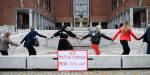
Amid intensifying global disorder, we need new strategies for practising democracy and for questioning the systems and structures within which we operate. We will hear from people with wide experience from higher education, from perspectives of learning, teaching, and artistic practice.
We ask:
- What does activism look like within academia and why is it needed?
- What are the relations between activism and the principles of academic freedom?
- What can academic activism learn from artistic activism?
- What are the potentials, challenges and pitfalls of promoting activist practices through research and teaching?
- Can activism inform radical imaginaries of change and what is possible?
The sessions are free to attend, no registration needed, simply turn up!
13:10-13:55: Session 1:
Academic freedom and activism - what is it and why do we need it?
In this session we discuss how activism can be understood within the context of academia. Why do we need activism in academia? What institutional structures and systems must be navigated when being a rebellious academic? What role(s) do the principles of academic freedom play in supporting or compromising academic activism and, ultimately, democracy?
Introduction: Why activism and academic rebellion? by Camilla Eeg-Tverbakk and Cecilie Sachs Olsen
Panel discussion participants:
- Noah Sobe (UNESCO)
- Pål Nygaard (BI)
- Asma Abu Samra (Scholars at risk)
- Thais Alfaro Sandoval (Students at risk)
Moderator: Erik Sveberg Dietrichs (Young Academy Norway/Akademiet for Yngre Forskere)
14:05-14:45. Session 2:
The arts of rebellion - how to practice activism?
In this session we look at what activism could look like, and how it can be practiced.
Focusing on art activism that employ artistic and performative methods to effect change, we look at how existing institutional structures can be subverted through adopting and learning from artistic interventions to experiment with playful pedagogical experiments and research strategies.
How can we teach active citizenship among students within academia? How can teaching itself be(come) a rebellious act?
Introduction: What can we learn from art activism in practising rebellion? by Cecilie Sachs Olsen
Panel discussion participants:
- Sara Baban (artist)
- Camilla Eeg-Tverbakk (OsloMet)
- Sara Christophersen (UiO)
Moderator: Cecilie Sachs Olsen
Session organizers: Camilla Eeg-Tverbakk and Cecilie Sachs Olsen
Conference organizers: SDG program comitee (uni.oslomet.no)
Sessions/panel discussions at the SDG Conference: Education Unscripted – the Quest for Truth, Collaborative Transformation & Solidarity (uni.oslomet.no)
