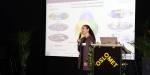
What can and should a university do when the world faces major climate and environmental challenges? This was the overarching question when researchers, lecturers, students and representatives of the university leadership gathered for OsloMet Green Transitions Day on 15 October 2026.
The conference featured around 40 contributions from different academic communities, with participants from all of OsloMet’s faculties and centres, as well as guests from other research and educational institutions.
A wide range of activities
“The contributions demonstrate the remarkable range of relevant activities taking place and show that the green transition concerns far more disciplines than those traditionally associated with climate and the environment,” says Senior Adviser Stefan Erbs, who led the organisation of the event.
“At the same time, this represents only a selection of what is happening at OsloMet. One thing we discovered while reaching out to and mapping our academic communities is that much of this work is not necessarily visible across the university.”
The event was organised by Green Energy Lab and OsloMet’s strategic research initiative on the green transition. One of its main objectives was to help academic communities learn more about each other’s work and lay the foundations for new collaborations.
During the preparations, the organisers discovered that far more work on the green transition was taking place at OsloMet than they had anticipated. The conference could therefore showcase only a selection of this extensive activity.
The green transition requires different disciplines
A recurring message throughout the day was that the green transition is not just about developing new technology or reducing greenhouse gas emissions. It is also about how people live, what we consume, how society is organised and what changes we are willing to make.
The presentations demonstrated how different academic communities are addressing these challenges.
Researchers presented work on topics including low-carbon concrete, renewable energy systems, more environmentally friendly drug development and measures to tackle plastic pollution. Others explored how artificial intelligence affects resource consumption, how food waste can be reduced, and how economics, management and political decisions can contribute to the transition.
Education was another central theme. Several contributions demonstrated how university students, school pupils and preschool children can gain the knowledge, experience and skills they need to participate in societal change.

An overview of the beautifully curated Transitions exhibition. Photo: Olav-Johan Øye
A dedicated exhibition, Transits, combined art, design and research communication. Among other things, it explored how people experience wind power developments and how artistic expression can open up new perspectives on sustainability.
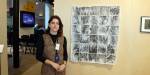
Postdoctoral researcher Sofia Rafaella Greaves was among the exhibitors at Transitions. Photo: Olav-Johan Øye
Collaboration strengthens the strategic initiative
An important part of the conference was the presentation of ten interdisciplinary projects that have received funding through OsloMet’s strategic research initiative on the green transition.
The projects cover areas including industrial transformation and offshore renewable energy, resource use and circular solutions, as well as issues relating to governance, digitalisation and a just green transition.
The initiative aims to build stronger research communities and foster collaboration across disciplinary and organisational boundaries.
A central question throughout the day was how the university could move from numerous individual initiatives towards a more coordinated and long-term approach.
“By working together, we can ask better questions, understand more aspects of the challenges and develop solutions that take several factors into account at the same time. But this also requires giving people opportunities to meet, learn about each other’s work and develop collaborations over time. Interdisciplinary collaboration does not happen simply because we encourage it.”
OsloMet’s interdisciplinary strengths
“One of OsloMet’s greatest strengths is its combination of expertise in technology, social sciences, health sciences, education and the arts, along with the close links many of these academic communities have with professional practice and wider society.”
“The green transition is not just about developing new technology. It is also about how society is organised, how we educate future professionals, how changes affect people and local communities, and how we can develop solutions that are both environmentally and socially sustainable. OsloMet has much to contribute in these areas.”
What should OsloMet contribute?
The conference highlighted OsloMet’s responsibility as an institution with a wider role in society.
Research should generate new knowledge and solutions, but the university must also educate future professionals, collaborate with working life and wider society, and contribute to critical debate about what the green transition should involve.
Students were highlighted as important participants. Among other things, the Student Parliament presented a proposal for a Green Office that could strengthen collaboration between students and staff.
From promising initiatives to lasting change
A central question at the conference was how OsloMet could move from numerous promising individual initiatives towards a more coherent and long-term effort. This was also a key point in the presentation by Linn Dybdahl from the Norwegian University of Life Sciences (NMBU), who shared findings from a review of sustainability work at seven Norwegian universities.
Dybdahl highlighted the distinction between adding new sustainability measures to existing activities and making more fundamental changes to how universities are organised, governed and run.
“A great deal of good work is already under way, but the challenge is to create structures that prevent initiatives from remaining isolated. We need to move beyond simply adding new measures to existing activities and consider how we organise, prioritise and develop the university over time,” says Erbs.
He points to the strategic research initiative as an important step in this direction.
“The initiative aims to build academic capacity and collaboration across disciplines, which in the longer term can also strengthen our ability to attract external funding. But we cannot rely on externally funded projects alone for long-term development. We also need to invest in the university’s own capacity.”
“The diversity and initiative shown by our academic communities are major strengths, but we cannot base long-term development solely on dedicated individuals and temporary projects. We need clear responsibilities, resources and lasting roles and support functions that build bridges between academic communities, faculties, university leadership and external partners, and that support collaboration over time.”
“I hope the conference can serve as a starting point for precisely this. We have made much of the ongoing work more visible and established new connections across the university. The question now is how we build on this so that our research, education and collaboration can make a greater contribution to the green transition in society.”
ChatGPT was used as an aid in translating into English. The text has been quality-assured by OsloMet.
The main photograph first in the article, shows Professor Parisa Gazerani delivering her presentation during the session Research, Transition Practices & Innovation: What responses are already taking shape across OsloMet?

How can universities enable meaningful participation in shaping green transition processes and turn promising initiatives into lasting institutional capacity? The panel comprised Carl Christian Thodesen (OsloMet), Helge Jordheim (Centre for Global Sustainability, University of Oslo), Arvind Keprate (OsloMet’s strategic research area for the green transition), Yosef Sium Ihdego (Student Parliament, OsloMet) and Linn Dybdahl (Norwegian University of Life Sciences). Photo: Olav-Johan Øye
