OsloMet, 3 June 2026, 10:00. Auditorium PH170 in Pilestredet 35 fills with the sounds of the Finnmark Plateau – wind, running streams, whistling, and gradually the voice of renowned Sámi musician Georg Buljo.
When he performs his joik “Embrothered,” composed some years ago for Britta Marakatt-Labba and her art, she is visibly moved. This musical tribute sets the tone for a very special morning in June, where two new honorary doctors at OsloMet are celebrated in a seminar focused on freedom of expression and democratic resilience.
United in their commitment to freedom of expression
These are honorary doctors aren't just anybody: internationally acclaimed textile artist, printmaker and painter from Sápmi, Britta Marakatt-Labba, and Filipino journalist, author and editor Maria Ressa, who was awarded the Nobel Peace Prize in 2021. Two women with very different backgrounds and forms of expression, yet united in their courage, their democratic strength, and their commitment to defending freedom of expression.
Rector Christen Krogh opened the seminar by reminding the two honourees that they now have an academic home at OsloMet. He highlighted how the university awards honorary doctorates within fields where OsloMet itself grants PhDs, and to individuals who have distinguished themselves in areas closely connected to the university’s work. These appointments also support OsloMet’s goals of sustainable development, a well-functioning democracy, and building competence for a world in constant change.
Resistance to oppression
Key works by Britta Marakatt-Labba were shown on a large screen as she spoke with Camilla Frøland Sramek, senior curator at the National Museum and one of the three curators behind the exhibition “Sylkvasse sting” in 2024.
We were given insight into her work Giving Birth (Riegádahttin) from 1983, which takes its starting point in her own birth in 1951. She was born in a lávvu during the autumn reindeer migration, when the animals, having grazed in Norway over the summer, were on their way to winter pastures in Sweden. In this way, Britta was born near the border between the two countries, close to Idivuoma/Ađevuopmi.
We also heard about the monumental seven-year process behind the 24-metre-long embroidered piece “Historjá,” as well as the iconic work The Crows (Garjá) from 1981. It depicts a flock of crows gradually transforming into police officers, who then use force and violence to arrest demonstrators during the Alta protests.
Through images and words, it became clear how Marakatt-Labba’s unique visual storytelling – using the “gentle” materials of needle and thread – conveys powerful messages about resistance to oppression, the struggle for Sámi identity, and the protection of our natural heritage. Her work illustrates how art can be an indispensable tool for democratic expression and participation.
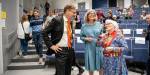
Rector Christen Krogh, pro-rector for research and development and new honorary doctor Britta Marakatt-Labba. Photo: Sonja Balci / OsloMet
“Democracy is at stake”
The second part of the seminar began with a powerful lecture by Maria Ressa, who emphasized that the “mother of all battles” is the fight for information integrity. Ressa has long been vocal about the need to regulate big tech companies and hold them accountable.
“Time is running out,” she said. In an information ecosystem where lies spread six to eight times faster than the truth, and where those distributing information have either abandoned all responsibility for truth or have much to gain from manipulating us, our democracies are at risk.
Without facts, no truth – and no trust
Ressa referred to a March report from the Swedish V-Dem Institute, which found that 74 percent of the world’s population lives in countries experiencing autocratic pressures.
“Without facts, there is no truth. And without truth, you cannot have trust. Without trust, we do not share a common reality – and without that, democracy becomes impossible,” she said.
She stressed the need for a shared understanding of reality as a foundation for discussing and solving the challenges we face.
She described a narrowing window of opportunity – one that may lead to the erosion of both free media and, ultimately, democracy itself.
In a follow-up conversation with Professor Kristin Skare Orgeret, however, Ressa also expressed cautious optimism. She highlighted the importance of collaboration and the determination to “hold the line.” Her own story – marked by courage and perseverance in holding power accountable, even in the face of threats, harassment and persecution in the Philippines – offers hope and shows why she has become a global symbol of integrity and democratic resilience.
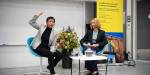
Maria Ressa in conversation with professor Kristin Skare Orgeret. Photo: Sonja Balci / OsloMet
A new research initiative on democracy
In their different ways, both honorary doctors made it clear that a durable democracy depends on people who are willing to defend truth, memory and human dignity when these values come under pressure.
The seminar also marked the launch of OsloMet’s new thematic research initiative, A Durable Democracy. The first ten research projects, which together have been awarded nearly NOK 8 million, were presented, demonstrating how they aim to generate new knowledge to understand, protect and strengthen democratic resilience – particularly in the face of some of the defining challenges of our time.
-
Strategic research areas
OsloMet's four strategic research areas aim to promote and strengthen the university's research and knowledge development in key areas. The strategic research areas will last for five years, from 2026 to 2030.
-
A Durable Democracy
This strategic research area explores how democracy can be strengthened and further developed in the face of challenges like weakening democratic structures, increased disinformation, polarization, and declining trust.