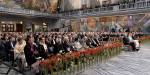
The Occupation Frieze in Oslo City Hall does not only depict the course of the war in Norway. It is also closely interwoven with the artist’s own life.
Alf Rolfsen’s family served as models; the interior of the living-room scene comes from his own home, and the young man rising up against oppression is his son, Jens Christian.
Professor Arild Skarsfjord Berg and Assistant Professor Christian Nordahl Rolfsen from OsloMet unfold new interpretations of Alf Rolfsen’s Occupation Frieze (1947–1950) using letters, sketches and photographs from the family archive.
“You can quite literally see the episodes described in the letters depicted in the Occupation Frieze,” says Christian Nordahl Rolfsen, Alf Rolfsen’s grandson.
Knowing this changes our gaze: anonymous figures become recognisable people, and the frieze acquires a documentary dimension – it is not just ‘freely composed’ images of war, but snapshots of lived lives.
The son who never got the chance to become an engineer
At the heart of the personal story is Jens Christian Rolfsen, who took part in clandestine resistance work, fled through the forest ‘Tolvmilskogen’ to Sweden in 1944, and later enlisted in the navy in England.
His letters convey youthful zest for life and his future plans to become a naval engineer, with his practical training from the shipyard ‘Nylands Verksted’.
In the frieze, he is painted as the light-toned figure who rises; his gaze is directed across the hall towards the motif of ‘Nylands Verksted’, the shipyard that is the site of his dream for the future.
He died the day after his 21st birthday when the corvette ‘Tunsberg Castle’ went down off Båtsfjord in Finnmark in Northern Norway on 12 December 1944.
“At least he kept the dream – for ever – in the painting,” says Berg.
Gestapo enters the home
Berg and Rolfsen describe the frieze as a story in five acts:
- attack and blackout
- the Gestapo entering the home
- the destruction of culture, with references to the Caryatids of the Acropolis
- emerging resistance and captivity
- liberation and celebration
Visually, the acts are tied together by consistent formal compositions: straight lines, diagonal movements and divisions of the picture plane that interact with the hall’s architecture.
The Cubist simplification provides structure and direction without losing the figurative and recognisable elements. Cubist simplification means reducing motifs to clear, geometrical forms and planes so that structure and composition stand out more clearly than naturalistic detail.
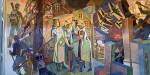
Section of the Occupation Frieze, showing the beginning of the war. © Alf Rolfsen / BONO. Photo: Arild Skarsfjord Berg
From home environment to monumental artwork
The frieze contains concrete details from the Rolfsen family’s everyday life: his wife Ingrid, the children Egil and Kirsten, the mother-in-law, the living-room furniture – even the corner cabinet with the bowl and Nordahl Rolfsen’s standing desk.
Christian Nordahl Rolfsen describes a clear working method: models posed and photographed, sketches drawn, small colour studies painted – and then scaled up via cartoons to full size.
In the City Hall’s main hall, everyday life and close relationships are thus transformed into national monumental art.
Light and style set the mood
The fresco technique – painting with mineral pigments onto wet lime plaster – demands speed, as it dries quickly. It lends a ‘freshness’ to the brushwork that makes the scenes vivid.
Especially in the Occupation Frieze, which is more dynamic and diagonal in its emphasis than the more static ‘The Land’ on the north wall, the technique generates a sense of urgency that accords with the chaos of war.
The Cubism-inspired yet still figurative style, and the carefully considered lighting in the hall – with shifting daylight and strategic artificial light – heighten the drama.
The ornament along the walls, also designed by Rolfsen, ties motif and architecture together.
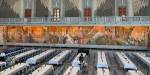
Here you can see the entire Occupation Frieze. © Alf Rolfsen / BONO Photo: Arild Skarsfjord Berg
A timely human story
In public works intended to represent the nation, the collective and the political have often been foregrounded.
“The personal perspective hasn’t been much discussed before,” says Berg.
Berg and Rolfsen (the grandson) show how Alf Rolfsen balances this:
The frieze documents occupation and resistance at a societal level, while also being grounded in the artist’s own grief and family history.
This makes the work more than a historical overview. It becomes a human story with resonance and relevance, especially when seen in light of today’s conflicts.
Written and oral sources cast new light on the work
Christian Nordahl Rolfsen has documented sketches and photographs in the family archive and interviewed relatives and models from 1989 – 1991.
In Berg and Rolfsen’s academic article, deliberate ethical boundaries have been observed, including omitting material that might unnecessarily expose personal information.
Methodologically, there is an interplay between written sources (letters, transcripts), visual traces (sketches, photos) and oral testimony – a triangulation that strengthens the documentary reading of the frieze.

Arild Skarsfjord Berg and Christian Nordahl Rolfsen have reviewed letters, sketches and photographs from the family archive, and can therefore tell us how a personal story of wartime memories lies behind Alf Rolfsen’s Occupation Frieze. Photo: Arild Skarsfjord Berg
The frieze activates the space
Berg and Rolfsen highlight how the frieze activates the space: the son’s line of sight towards ‘Nylands Verksted’ on the west wall; the St Hallvard motif (modelled on his brother Egil) that flows into ornament and binds surfaces and subject matter; and lines that ‘click’ with the hall’s architecture.
In this way, Rolfsen creates relationships across the walls – not only within the frame of a single image.
Berg and Rolfsen point to film and digital formats as particularly effective ways of conveying this to young people, preferably supplemented by letters read aloud—because they convey a recognisable youthful voice.
The City of Oslo Art Collection has made a film about the frieze, featuring Rolfsen and Berg (youtube.no). The film is subtitled in many languages using AI.
Why this matters to us today
The frieze can readily be linked to the wars of our own time to underline its relevance.
The Occupation Frieze is both a site of remembrance and a lesson for the present. It shows that public art can encompass individual lives and losses – and that the personal can be connected to the political.
When we know who is standing in the living room, what their names are, and what they dreamt of, the history of war feels less remote. It is given a face.
The image at the top of the article shows a detail from the Occupation Frieze.
Reference
Christian Nordahl Rolfsen and Arild Berg: A deeper insight into the Occupation Frieze by Alf Rolfsen in Oslo City Hall. Kunst og Kultur, vol. 107, issue 3–4. 96–109 (published in Norwegian).