The project that culminated in a dance performance began when a choreographer and a professor of fluid dynamics happened, by chance, to strike up a conversation at an exhibition about their disciplines: dance and turbulent flows.
Choreographer Dr. Karolina Bieszczad-Stie describes it as a creative impulse: she becomes curious when she doesn’t understand something and uses dance to explore what feels incomprehensible.
“I use dance to understand, process, or explore things”, says Karolina.
“Here I knew there was something I couldn’t immediately grasp, but intuitively I felt there was value in letting the two fields collide.”
Professor Ramis Örlü, who has researched turbulence for 20 years, opened up a world of paradoxes for her.
“We will never be able to eliminate turbulence, but we can try to understand it, live with it and steer it towards a more economical, ecological and sustainable direction.”
In the lab, laser and smoke made the phenomenon visible and mesmerising, thereby sowing the seed of the project.
Building a shared language
They spent hours at a whiteboard with sketches and terms like “coherent structures”, “instabilities”, and “white”. The same words carried different meanings.
“White is not a colour, for a physicist”, Ramis wrote in an email when they were discussing lasers and safety glasses. The differences became a creative space rather than a barrier.
Sometimes it was crucial to find shared terminology; at other times, the distance between words became material for the choreography.
Turbulence as a co-dancer
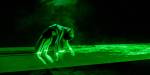
“We choreograph the turbulence and we choreograph the human dancer. It’s a duet between them”, says Karolina.
Smoke and light make turbulence tangible in the space, while the dancer draws on the inner mechanics of vortices – their buildup, spin and release – as choreographic impulse.
Body, arms, hands, breath and heat are used to set air in motion and influence the turbulent flow in the smoke.
The choreography establishes them as two separate actors before exploring the journey from resistance to interplay.
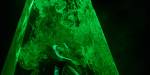
Here you can see how turbulence can take to the stage. Photo: Tale Hendnes
Sparking curiosity and recognition
Images and videos from the pilot project and dance production process have excited both researchers and people without an engineering background.
“People are surprised that they haven’t seen turbulent flows before, even though they surround us all the time. With smoke and lasers, they experience it for the first time”, says Ramis.
The goal is to give the audience space for their own interpretations and to show that turbulence is not just associated with negative thoughts.
Without turbulence, air wouldn’t mix, and this would have severe consequences for pollution, health and urban environments, because without this mixing, we would ultimately die from the buildup of polluted air.
The stage as laboratory
Equipment from the lab – a green stage laser, smoke and sensors – moves onto the stage, but the kind of control you have in the lab becomes impossible: temperature, ventilation and an audience that breathes and moves all affect the flow field.
“We realised quite quickly that we cannot control it. Each person affects the smoke field just by breathing or moving their arms. That’s why every performance is unique”, says Ramis.
Sensors can measure the velocity field and modulate sound in real time; the instruments must be adapted to emphasise the dancer’s movement rather than irrelevant noise or fluctuations in the air.
It demands prototyping, adjustment and patience, just as in both art and science.
Working with constraints and uncertainty
Both fields combine free imagination with tight frameworks to make ideas work. Some things had to be discarded because the technology didn’t suit the stage, or because the choreography required clear constraints.
Karolina learnt basic physics to avoid superficial aestheticising and practised letting go of control.
“I often work with science and technology in my performances, and those systems usually come with clear constraints, boundaries and limits that shape the creative process”, says Karolina.
“But what’s unique about this project is that the core constraint is the opposite: a lack of control. You can steer the laser, but you can’t fully steer the air.”
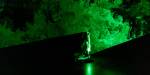
Illuminated smoke shows how turbulence unfolds in space, and how it can be influenced. Photo: Tale Hendnes
Challenging the research
Art’s questions brought new perspectives: whilst turbulence is undeniably complex, it is actually the stable laminar flow that proved impossible to achieve on stage.
“I’ve been teaching for 20 years, yet during our pilot project the artists asked questions that none of my students had asked before. It’s a vivid reminder of how art and dance can spark truly out of the box thinking”, says Ramis.
The project strengthened the dissemination of why engineering concerns everyone. Turbulence affects aerosols, ventilation, transport and urban air quality.
“The air we breathe in is turbulent; the air we breathe out is turbulent. Everything around us is turbulent”, says Ramis.
An hour of intense turbulent flow can change how we view the room: in- and out-breaths, cooking fumes and wind, for example, are all turbulent.
Leaving your comfort zone pays off
Ramis finds that artists and audiences are fascinated by his work.
“For the first time, I feel that what I do also interests people outside engineering. It has social significance.”
Karolina sees how disciplinary boundaries can be negotiated: you can create a shared conversation between standpoints that don’t usually meet. In a polarised time, the message becomes concrete: step out of your comfort zone. It pays off.
“As knowledge fragments into ever narrower areas of expertise nowadays, no single field can hold the whole picture. That’s why building shared spaces for exchange, and creating interdisciplinary projects and dialogues, is more important than ever.”
“They allow different forms of expertise to meet, rub against each other and produce new questions, together. We have a lot to learn from each other, including in ways that strengthen our own disciplines.”
A deeper understanding of turbulence
The performance follows the journey from resistance to interplay and leads the audience’s gaze from pure aesthetics to understanding movement, coherence and change.
“I like to leave it open for the audience, what they will feel and take with them”, says Karolina.
“But I hope they’ll leave with new, more nuanced connotations of turbulence – something broader than the familiar moment of fear when the aircraft suddenly shakes.”
Art opens the gaze
Art does not replace theory or measurements but opens the gaze: it makes phenomena sensuous and accessible and shows that technical themes are also deeply human.
The result is a meeting between precision and imagination. A laboratory on a stage, a dance with the air, and for those who watch, perhaps a new way of thinking about the world that exists between black and white.
Go to see the performance (dansenshus.no).