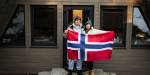
“One of the people we interviewed described how happy she was at her first work party. After having a few beers with her colleague, she finally felt they managed to break through the polite surface and really talk,” says researcher Tone Liodden, adding:
“The disappointment was all the greater when the colleague she had laughed and chatted with the night before barely said hello the next day.”
It was as if the closeness from the night before had never happened.
“It almost feels like Norwegians practice a friendship version of a ‘one-night stand.’ You can have one night of intimacy, but it doesn’t develop into a lasting relationship. Poof – the next day you’re back out in the cold again,” says Liodden.
Social scarcity as a challenge
Liodden is a researcher at the Norwegian Institute for Urban and Regional Research (NIBR) at OsloMet, and together with colleague Marianne Tønnessen, she has studied why people move away from Norway.
“Based on our analyses, it seems that social energy is perceived almost as a scarce resource in Norway,” says Liodden.
Traditional explanations for why people choose to move to other countries emphasize economic motives – especially experiencing economic scarcity in the country you leave.
“Our data, however, show that social scarcity may be just as important. At least for some immigrants,” says Liodden.
Many of those interviewed were highly educated, sought-after labor migrants without children or partners.
“For them, an active social life may be a particularly important factor when deciding whether to stay or leave Norway,” she says.
It almost feels like Norwegians practice a friendship version of a one-night stand.– Tone Liodden

Invisible fences and structured social lives
Liodden refers to research by Norwegian social anthropologist Marianne Gullestad, who says Norwegian social life is regulated by “invisible fences” that mark who is inside and who is outside.
“Precisely because these fences are invisible, it’s hard to understand what’s going on for those who encounter them. Norwegians are described as polite but dismissive – but the dismissal is subtle,” says Liodden.
Although the researchers acknowledge that it always takes time and can be challenging to get new friends when moving to a new country or place, they believe it seems especially demanding in a country like Norway.
“One reason it’s extra challenging in Norway may be the emphasis on peace and quiet in Norwegian culture. Social relationships can obviously seem disruptive here. They can simply be a bit of a bother,” says Liodden, elaborating:
“In Norway, it’s absolutely legitimate to withdraw based on a desire for “alone time”. That’s not necessarily the case in other cultures.”
Other factors the researchers believe play a role include the fact that social life in Norway traditionally has taken place largely at home. There may also be strong norms against mixing friends from different circles.
“There’s also a strong tendency for people to have friendship circles formed early in life. They often don’t expand much as you get older,” says Liodden.
In addition, gender equality in Norway leads to a strong focus on “family time” at home, where both parents are expected to participate. That leaves little time for much else.
“And social life in Norway is often structured, planned, and not very spontaneous,” says Liodden.
Hard to talk about
Many people wanted to share their story about why they moved away from Norway.
“It was as if there was a great need to speak freely about things that maybe aren’t so great about Norway and Norwegian way of life,” says Liodden, adding:
“Many of us who live in Norway think we’ve won the lottery. That Norway is simply fantastic. But then why do 30,000 people move away from Norway every year?”
The researchers interviewed people who have moved or are considering moving from Norway to find the answer.
“Several said exactly that – that this was a bit hard to talk about, because there’s a strong perception in Norway that we live in the world’s best country. And that the general feeling is that if you don’t think so – well, maybe you should keep it to yourself,” says Liodden.
About the EXITNORWAY project
- Name: Emigration from today’s Norway: Who, why, and how does it shape Norwegian society? (EXITNORWAY)
- Period: 2021–2025
- Funding: Research Council of Norway
- Project leader: Marianne Tønnessen, Norwegian Institute for Urban and Regional Research (NIBR)
- The project examines who moves away from Norway, why they leave, and how emigration affects Norwegian society.
- You can read more about the project on their website (uni.oslomet.no).