Research groups
- Building technology, building materials and building physics (B3)
- Digital & Sustainable Construction (DiSCo)
- Smart Water Engineering Group (SWING)
- Structural Engineering Research Group (SERG)
- Sustainable Built Environment (SustainaBuilt)
- Transport, Infrastructure, and Urban development (TransFrUrban)
Research projects with their own webpage
Research publications
- Research publications related to Department of Built Environment 2026 (nva.sikt.no)
- Research publications related to Department of Built Environment 2025 (nva.sikt.no)
- Research publications related to Department of Built Environment 2024 (nva.sikt.no)
- Research publications related to Department of Built Environment 2023 (nva.sikt.no)
- Research publications related to Department of Built Environment 2022 (nva.sikt.no)
- Research publications related to Department of Built Environment 2021 (nva.sikt.no)
The publications are registered in Norwegian Research Information Repository (NVA), the Current Research Information System in Norway.
PhD programme
-
Engineering Science
This PhD programme is building on applied mathematics and physics, technology and engineering.
-
Innovation for Sustainability
The PhD programme in Innovation for Sustainability is interdisciplinary, applied and project oriented.
Laboratories
Concrete Laboratory
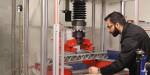
The Concrete Laboratory provides facilities for teaching and research in Civil Engineering. It is used for laboratory courses at both bachelor’s and master’s levels and supports student thesis projects and ongoing research activities.
The lab contains:
- mixers: Hobart mortar mixer, concrete mixer, Kenwood mixer 666 rpm
- curing and thermal chambers: drying oven up to 100°C, microwave, freezer, fridge, water curing chambers with controlled temperature, accelerated water curing chamber up to 100°C
- measuring equipment for fresh properties: TAM air calorimeter, flow table (manual), Vicat needle apparatus (manual), air entrainment meter, Vebe-consistometer, Abram’s cone, J-ring,
- measuring equipment for hardened properties: compressive and flexural strength tester, extensometer, creep tester, water permeability tester, Buoyancy balance
- Non-destructive testing equipment: speedy moisture tester, In-situ concrete strength tester, concrete resistivity meter, concrete durability tester, Schmidt concrete hammers, Profometer-Covermeters (rebar locator), displacement sensors
- environmental sensors: thermohygrometer, multimeter
- other equipment: pH meters, heating plates with stirrer, sieve shaker machines, precision weighing instruments, automatic mortar and pestle mill, datalogger, core drilling machine, hydraulic saw, specimen grinding machine, electric rebar cutter, vibrating table, concrete needle vibrator
This laboratory also shares important equipment with the Department of Mechanical, Electrical and Chemical engineering (MEK) such as SEM, UV/VIS, FTIR, HPLC centrifuge, Digital Image Correlation (DIC) equipment, microhardness testers, furnace up to 1400°C and tensile tester.
The concrete lab also has access to the freeze-thaw chamber in PH856.
The lab is located at P35-PE025.
Contact
SmartMet Lab
The SmartMet Lab at OsloMet specializes in smart infrastructure monitoring and maintenance, employing cutting-edge technologies like drones, robotics, AI, digital twins, and advanced cameras.
The lab focuses on enhancing the safety, resilience, and sustainability of infrastructure such as bridges, tunnels, roads, and buildings, including underwater structures. It drives innovation in sustainable infrastructure through advanced technology, interdisciplinary research, and practical applications.
Key Focus Areas
- Smart Monitoring: Utilizing different types of drones and robotics for inspections, including aerial drones for structural assessments and underwater robotics for submerged infrastructure.
- AI and Predictive Maintenance: Machine learning models to identify and predict issues for efficient maintenance planning.
- Digital Twin Technology: Virtual models to analyze and forecast infrastructure performance.
- Collaboration: Partnering with industry, academia, and public stakeholders to deliver practical solutions.
Facilities and Technology
- High-Performance Computers: Powerful computing systems designed for simulation, modeling, and data analysis.
- Advanced Sensors and Cameras: Including LiDAR, strain gauges, accelerometers, and imaging tools for precise monitoring and data collection.
- Drones and Robotics: A range of aerial drones and underwater robotics tailored for over- and underwater infrastructure inspections.
- Collaborative Spaces: Dedicated areas for brainstorming and interdisciplinary research.
For Students and Researchers - Hands-on experience with drones, robotics, and advanced data collection tools.
- Opportunities for interdisciplinary research in civil engineering, AI, and environmental monitoring.
Location
Room: PI 847, Pilestredet 35
Contact
Smart Mobility Lab
The Smart Mobility Lab at OsloMet specializes in developing innovative solutions for sustainable urban transport, with a focus on intelligent transportation systems, shared mobility, active mobility, and data-driven decision-making tools to support smart and sustainable cities.
The lab focuses on enhancing the safety, resilience, and sustainability of urban transport networks by integrating advanced technologies, promoting multimodal mobility, and leveraging real-time data analytics.
Through interdisciplinary research and close collaboration with public and private sector stakeholders, the lab aims to address pressing mobility challenges and contribute to the transition toward low-carbon, inclusive urban environments.
Key Focus Areas
- Active Mobility: Promotion of walking and cycling through infrastructure design, safety analysis, and behavioural studies to support healthier and more sustainable travel modes.
- Data-Driven Mobility Planning: Application of big data, AI, and simulation models to inform transport policies, optimize operations, and support scenario-based planning for future mobility systems.
- Sustainability and Emissions Reduction: Assessment of environmental impacts from transport activities and development of low-emission strategies in collaboration with local authorities and industry partners.
- Multimodal Transport Planning: Development of integrated mobility strategies that connect various modes of transport – such as walking, cycling, public transport, and shared mobility – into seamless, user-centred travel chains.
- Transport Poverty and Equity: Research and interventions aimed at identifying and addressing transport-related social exclusion, ensuring equitable access to mobility services for underserved communities, and reducing barriers related to cost, availability, and physical accessibility.
Facilities and Technology
- Simulation and Testing Platforms: Software and hardware setups for virtual testing of mobility scenarios, agent-based models, and traffic simulations in controlled environments.
- Advanced Sensors and Cameras: Including LiDAR, Eye Tracker, accelerometers, and imaging tools for precise monitoring and data collection.
- Comprehensive Data Sets: Access to diverse datasets covering mobility patterns, transport infrastructure, emissions, accessibility, and user behaviour. These datasets are collected via sensors, surveys, APIs, and open data portals, and are used to support data-driven research, modelling, and policy development.
