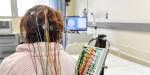
These findings come from Rabindra Khadka’s doctoral work in engineering science at OsloMet.
Currently, many people undergo costly brain scans or have samples of cerebrospinal fluid taken to investigate Alzheimer’s. This can be burdensome and is not always easy to access.
The EEG brain test is already available in many hospitals and clinics; it is affordable and does not hurt. If we can detect early signs of disease using EEG, more people can receive assessment sooner.
“Our aim was to detect early dementia so that we can help these people, that is the main goal,” emphasises Rabindra Khadka.
How it works
- EEG picks up brain activity. The AI model learns to recognise patterns linked to Alzheimer’s.
- When EEG data are combined with simple information about the person, for example age or results from cognitive tests and other clinical information, accuracy improves.
- The AI model first trains on large amounts of brain signals to become good at spotting patterns, and is then fine‑tuned on smaller datasets where researchers know more about the participants.
- In addition, researchers look at short, repeating patterns in the brain signals. These can provide simple explanations that help professionals understand what the model focuses on.
“With electrodes on the head instead of needles, we get a window into the brain, how it works,” explains Khadka.
Simpler, faster and more affordable
This is the first time anyone has shown that EEG, together with demographic and clinical personal information, can estimate the level of an Alzheimer’s‑related blood marker known as p‑tau217.
A tailored AI framework has been designed to identify how brain activity evolves over time, while also explaining how it reaches its decisions.
The model has been made lighter and faster, so the analysis can in principle run on simpler equipment close to the patient.
“As far as I am aware, this is the first time anyone has tried to predict p‑tau217 from EEG. The results are preliminary, but very promising,” says Khadka.
Less burden and better access
“In practice, the patient avoids a painful process involving blood tests or spinal fluid sampling. If we can estimate the level within a certain margin of error, that is a big step forward.”
Electrodes on the head rather than needles and expensive scans can reduce the burden on patients. EEG is also widespread and can be used in more places across the health service.
“EEG is affordable, portable and can be used in many clinics and smaller hospitals, including in countries with fewer resources,” says Khadka.
“With this kind of system, doctors get an extra assistant that provides feedback based on a biomarker, without a long and expensive work‑up.”

Rabindra Khadka's goal is earlier and less stressful dementia diagnosis. Photo: Olav-Johan Øye
More research is needed first
The results must be confirmed in larger and more diverse patient groups before the method can be adopted.
More standardisation is also needed. EEG measurements can differ from place to place, and quality can vary.
The next step is to show how reliable the model’s predictions are and to allow hospitals to work together to improve it, without needing to share sensitive patient data.
“A major limitation today is the amount of data. The model was trained and evaluated with limited data samples, and it included few severe dementia cases. The method needs broader testing, and we must show how reliable the estimates are,” says Khadka.
“If hospitals collect more data and we continue development, I can see a robust standard model being ready within five years.”
Privacy, with explainability
Although data in this project were processed in secure cloud services, Khadka points to solutions that can protect privacy even better.
“In future, data can be stored locally at hospitals. The model can also be sent to the hospital, trained on-site, and then returned without sharing any raw data,” he says.
“Some clinicians are sceptical of ‘black boxes’ where it is not clear how models reach their results. That is why we are working towards more transparency and explanations in the models.”
About the PhD
Rabindra Khadka completed his PhD at OsloMet’s Department of Computer Science, Faculty of Technology, Art and Design. He has developed methods that use EEG together with simple personal information to estimate Alzheimer’s‑related blood markers. The work emphasises explanations that professionals can understand and solutions that can work in practice.

