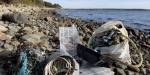
The students in OsloMet’s Tools4Ocean are helping to develop tools that can identify where plastic waste in oceans comes from. They hope to stop this plastic before it gets to the water by tracing pollution back to its source, a better solution than simply cleaning the shorelines.
Students are going out into the field to learn what people really need and then take that information back to OsloMet’s student-run makerspace to create and test effective solutions.
Growing from problem to solution
Plastic pollution, especially microplastics, is a major problem in the world’s waterways.
There are many volunteer-led cleaning projects in coastal areas like the Oslofjord trying to deal with the issue. People go out and pick up garbage from the islands and shorelines. It’s a great effort, but it only manages symptoms. To really solve the problem, we need the tools to stop it from getting there in the first place.
Head of Section at OsloMet Makerspace Notto Thelle and associate professor Artur Zolich say we need more information to really solve the problem of plastic pollution. “What is it? What kind of plastic is it? If you could determine what material it is while you pick it up, we can use statistics to find the major pollution origin.”
Knowing where the plastic comes from means they can address the problem at its source. Armed with a cell phone app and scanner attachment, Tools4Ocean will give ordinary people the ability to analyse the plastic waste they find and help the team determine where it came from. “It turns out that plastic polymers have a unique characteristic that we can trace” says Zolich. The source of the plastic – a careless factory, poorly designed trash depot, or litter in an area without bins – will inform policy to prevent pollution.
It’s a much more effective solution than just picking up plastic. “This project is very central to Oceanlab’s vision. The research will create technology that can map what is going on and suggest solutions for reversing the ecological collapse in the Oslofjord and elsewhere” says Thelle.
About the project
When OsloMet’s Oceanlab research centre opened in 2021, they had an ambitious goal of mapping and cleaning the Oslofjord using autonomous underwater robots.
They have hit the ground running with several projects funded by the EU and the Research Council of Norway, including Tools4Ocean.
Tools4Ocean is a major coalition of 15 partners from six different countries and led by the Norwegian Institute for Water Research (NIVA).
Students with prototyping superpowers
The driving force behind Tools4Ocean’s efforts are the students equipped with the prototyping and testing tools at the OsloMet makerspace.
Many universities have a makerspace – a resource with tools like 3d printers, sewing machines, and a machine shop – but OsloMet’s is special because it is student-driven and fully integrated into the university’s vision and strategies.
Not only that, but it is interdisciplinary. “This creates bigger opportunities than just working in the groups in your own bubble. You’re just as likely to see artists and designers as engineers” explains Zolich. Students who get this chance to collaborate across are able to create something extraordinary on their own.
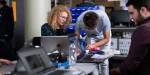
The students in OsloMet’s Tools4Ocean are helping to develop tools that can identify where plastic waste in oceans comes from. (Photo: Skjalg Vold / OsloMet)
It also means that Thelle and Zolich have an excellent pool of students to draw from when building their team.
Zolich says their approach in Tools4Ocean is a bit unorthodox. “Usually, these projects only have funding for one PhD student, and their focus has to be on producing scientific publications. But here, the students get the experience of real-life implementation and quite a lot of freedom to take it further into maybe a company or a startup.”
So instead of just one isolated grad student, Zolich and Thelle have a team of 5 (paid) graduate students and a slew of undergrads and their class projects supporting this effort.
They also have academic and technical backing from the Department for Mechanical, Electrical, and Chemical Engineering. Together, this structure lets them approach this project more like a startup company.
This leads to students who can try exciting new ideas for identifying the plastic waste and stopping it from getting into the Oslofjord. The training and experience produces effective ocean solutions and gives students the training they need to excel in the workforce.
Build and fail and build again
“There is this tight collaboration, not through research, but through education, that came from Oceanlab and this happening because of our students” says Thelle.
The team, including the students, have a big challenge ahead of them. They need to create a robust toolbox that is usable and trustworthy. Students will go out and work with people doing the field work and cleanup efforts to understand the design needs.
They will come back to the lab and Makerspace with this information to design, build, and assemble their solutions.
Then it’s what Zolich calls the most important loop for an engineer: “build, fail, learn something, do it again, go to the field with the volunteers, fail in a way no one expected, get positive comments, redesign, keep improving, start to understand and control the process. In engineering ‘overnight success’ stories are actually the result of several years of work.”
The project officially gets underway this Fall. The next six months will be spent mapping the project before moving on to development for the next several years.
Thelle and Zolich say it’s too early in the project to really know how it is going to end up. For now, they are focused on making sure that students are excited about the projects and education. Ultimately, Oceanlab and all the members of Tools4Ocean will create a system for getting information and integrating multiple tools to help understand our oceans. From there, they can inform sensible policy to fight pollution.