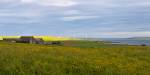
Residents see turbines from their kitchen windows, on their way to work or at the beach: energy installations that generate electricity are continuously present in people’s lives on Orkney.
Neil Gordon Davey’s doctoral research in innovation and sustainability at OsloMet highlights everyday life close to such energy installations, using cameras and photography as key tools.
Davey shows that people do not only hold opinions about turbines and other energy infrastructure, but that they live with them, interpret them and adapt to them in different ways.
“Energy development is nuanced and highly place-specific,” Davey emphasises, noting that people are adaptable: we often adjust in our own unique ways.
Some find practical meaning in it: turbine blades become weather indicators and landmarks. A quick glance at the direction of rotation tells you where the wind and the next rain squall is coming from.
Others ascribe personality to turbines: they get names, are described as ‘neighbours’, or as something to be ‘balanced’ in one’s garden and view.
The body can be involved too: participants swam on their back in time with the turning blades. Such everyday practices show how infrastructure becomes lived experience, not just something to look at.
Three types of responses
Davey introduces three different types of responses as a language for capturing the diversity of experience:
- Environmental responses: how wind turbines and other visible forms of energy infrastructure interact with their surroundings through light, siting and composition – and how people adjust routines and the way they look.
- Emotional responses: pride, hope, irritation, sadness, often at the same time. Meaning is not fixed; it is created in repeated encounters.
- Embodied responses: physical practices and orientation, from swimming and walking to using turbines as visual anchors in the landscape.
What does proximity mean?
Large turbines have been erected as close as 600 metres from people’s homes. That makes them so near that, for those who live there, they are almost continuously visible.
From the island of Sanday, Davey describes how the red aviation lights affect night-time views:
“It can be very disconcerting. Beautiful vistas are suddenly crossed by red lines, almost like a strobe effect, over the water and right up into the garden. It feels as if it is coming into the house.”
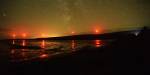
The aviation lights on wind turbines affect night-time views. Photo: Neil Gordon Davey Photo: Neil Gordon Davey
Findings from Orkney show that people develop their own, often creative strategies for coexisting with the installations, but they also point to the question of who should adapt to whom.
Should such installations be placed close to where people live, with the burdens that may entail? Or should planning, design and distribution models be changed so that the burdens are reduced and the benefits more fairly shared?
Justice out of sight
Orkney is often presented as a green frontrunner. However, the energy production is very visible, and locals often see limited benefits from installations, have few opportunities to influence decisions, and fuel poverty remains high.
People often cannot afford better energy provision and must spend a disproportionate share of their income on light and heat. Many live in older, draughty homes, and are dependent on expensive gas or electricity.
“If Orkney gets more turbines and other energy infrastructure that people see every day, something needs to be done about the benefits to the local community. The islands have high energy prices. I sat with people who were pouring buckets of (smokeless) coal into their fireplaces, and others chopping wood on the kitchen floor because it was too wet outside, with a view of five turbines that could potentially generate enough electricity for up to 10,000 homes on an island with 500 inhabitants,” Davey says.
“Many would call that an injustice.”
Using the camera as a conversation starter
Residents documented their own encounters with energy installations and shared photographs and reflections with the researcher.
“The visual element triggers conversations and emotions. When we look at the participants’ photographs, they can immediately return to how they felt at that moment, something standard interviews often miss,” says Davey.
He adds that current visual impact assessments are often carried out from selected vantage points, not from the living-room window, the kitchen, the commuter route or the beach where people walk with their dogs. Such experiences should be included in the methods, he argues.
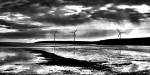
Here we can see that the view is strongly affected by energy infrastructure. Photo: Olav-Johan Øye
Could this be relevant in Norway?
Debates about wind power, power lines and solar farms often focus on kilowatt-hours, impacts on the natural environment and regulation.
Davey’s research shows that the transition is also cultural, sensory and social, and that everyday visual experience is a crucial factor regarding acceptance, conflict and participation.
“The most important thing we can do differently in planning is to integrate experiential methods that start from what people actually see, feel and do in their everyday lives, much earlier, and to continue with that throughout the whole process,” he says.
“And if measures do in fact reduce energy costs, people are more willing to accept them
How to better consider residents?
How can we better take into account people who live nearby and give them opportunities to influence decisions? Davey highlights:
- Use images actively in participation: let residents document their own landscapes before, during and after development, and discuss solutions based on these images.
- Take everyday visual experience seriously: do not only consider whether something looks ‘good or bad’, but how the installation is encountered in routines, movements and identity.
- Local energy justice: link visible interventions to concrete local benefits such as ownership, value and measures, and show how these can be distributed locally.
- Work on siting, axes, lighting and sightlines in close dialogue with those who live nearest.
- Shared spaces for interpretation can help: public exhibitions, audio-visual storytelling or guided walks in the landscape can build mutual understanding and trust.
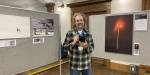
Neil Gordon Davey at the exhibition that went into his project. Photo: Veronica Sønsteby
The image at the top of the article is from the Orkney Islands with a view of wind turbines, photographed by Neil Gordon Davey.
Reference
Neil Gordon Davey: Altered landscapes of a post-carbon future. Exploring local stakeholder experiences and the visuality of energy development on the Orkney Islands. OsloMet Thesis 2026, No. 35.