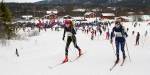
Skiing is often regarded as typically Norwegian: a heritage passed down from skiers such as Gjermund Eggen and Ole Ellefsæter. They came from modest backgrounds, as did Sondre Norheim, the crofter’s son from Morgedal who helped lay the foundations of modern skiing in the nineteenth century.
However, when sociologists Åse Strandbu (Norwegian School of Sport Sciences) and Kari Stefansen (NOVA, OsloMet) attended a youth ski race in Holmenkollen in Oslo in 2020, they encountered a different picture: expensive cars, technical ski clothing, and mirrored sunglasses. Several people carried devices holding multiple pairs of skis.
“We got the sense that something has changed,” they report.
They observed more adults than young people, and fathers in particular were active at the waxing benches – waxing appeared to be a purely parental activity. Several carried large cases filled with wax products.
Best chances if you have resourceful parents
A few years later, Strandbu and Stefansen published a study on what sociologists call “social closure” in Norwegian cross-country skiing. They write that the sport may be in the process of becoming reserved for the privileged few.
“We must distinguish between cross-country skiing as a popular recreational activity, which we still find in the mountains and on prepared trails, and what we see at youth ski races,” they explain.
It is the competitive branch they are discussing. Previously, participants could come from anywhere in the country and from all social backgrounds.
“Now it requires parents with money, time, and skiing expertise.”
One mother said that you practically need a PhD in waxing to keep up.– Researcher Kari Stefansen

Three types of parents
In the study, they interviewed 22 families – 28 parents in total – from various cross-country clubs across Norway. The parents, who have children aged twelve and upwards, described a process of professionalisation and commercialisation requiring substantial investment for their children to take part.
For some, this is unproblematic. For others, it is highly troubling.
“One mother said that you practically need a PhD in waxing to keep up,” says Stefansen.
The researchers divided parents into three groups: the genuine, who drive the development; the ambivalent, who recognise the problems but participate nonetheless; and finally the reluctant, a small group, many of whom eventually withdraw.
The parents feel they are simply doing what is necessary for their child to succeed in a demanding sport.– Kari Stefansen
May have grand plans for their children
“Parents in the genuine group could speak of their twelve-year-old as a potential world champion. If you believe your child will succeed, that legitimises an enormous parental effort,” says Stefansen.
This involves travelling to races, often every weekend and over long distances. It may require taking time off work. Parents also pay significant sums for equipment, training camps abroad, and private sports schools.
“There was little moral discomfort to detect. The parents feel they are simply doing what is necessary for their child to succeed in a demanding sport,” the researchers state.
They emphasise that genuine parents can be extremely important for clubs due to their extensive voluntary contributions.
Concerned, yet still involved
Ambivalent parents spoke about their children in more moderate terms, even if their children were also performing well. This was a large group, and they expressed concern about cultural changes within the sport.
Nevertheless, they did what was required to prevent their children from falling behind.
“By investing as though they accept what is happening, they help to legitimise what the genuine parents are doing,” says Stefansen.
Had they reduced their involvement, they would have felt as though they were distancing themselves from the skiing community, while also failing to take their child’s interest seriously, according to the researchers.
“That would represent a clear break with the involved parenting style that is dominant today,” says Strandbu.
The logic of elite sports is about to trickle down into youth sports. Ski races for Norwegian youth are reminiscent of World Cup races.– Åse Strandbu

Had given up trying to create change
Finally, there were the reluctant parents. They wanted a different sport, with less seriousness. Some withdrew from major competitions. Others had tried to change the culture within the parent group, without success. One mother, who herself had competed at a high level in cross-country skiing, said:
“I’ve probably stepped back a bit and don’t speak out as much anymore. It’s not easy to have been an athlete yourself and then tell grown adults what we ought to focus on instead.”
According to Strandbu and Stefansen, this group is important, even if small in their material:
“That these families also take part helps sustain the idea of cross-country skiing as a healthy and positive activity for young people.”
The professionalisation of the sport undermines some of the legitimacy of a sport that, like other sports in Norway, receives substantial public funding precisely because it is meant to be inclusive.– Åse Strandbu
May undermine the legitimacy of the sport
When Strandbu and Stefansen speak of closure within the field, they refer to theories by sociologist, philosopher, and economist Max Weber. Writing in the early twentieth century, he argued that fields once open can gradually close around particular groups.
Such processes often occur in ways those involved are only partially aware.
“It is easy to blame parents for what is happening, but cross-country skiing is now organised in ways that require high levels of investment. For example, sponsorship agreements are permitted down to early adolescence, which creates equipment pressure. An extensive race calendar is also allowed,” says Stefansen.
Norwegian children’s and youth sport has long been internationally successful, with high participation and significant voluntary parental involvement, she notes.
“However, among those active in cross-country skiing, we now see a particular type of parental investment – towards professionalisation and greater seriousness. This undermines some of the legitimacy of a sport that, like other sports in Norway, receives substantial public funding precisely because it is meant to be inclusive,” says Strandbu.
Source
Stefansen, Kari & Strandbu, Åse (2025). Social Closure in the Youth Sport Field: The Pull of the Game on Class-Privileged Parents. Sociology (journals.sagepub.com)
Read more about the project Young People’s Life Chances: How Inequality Develops During Adolescence (LIFECHANCES) funded by the Research Council of Norway.